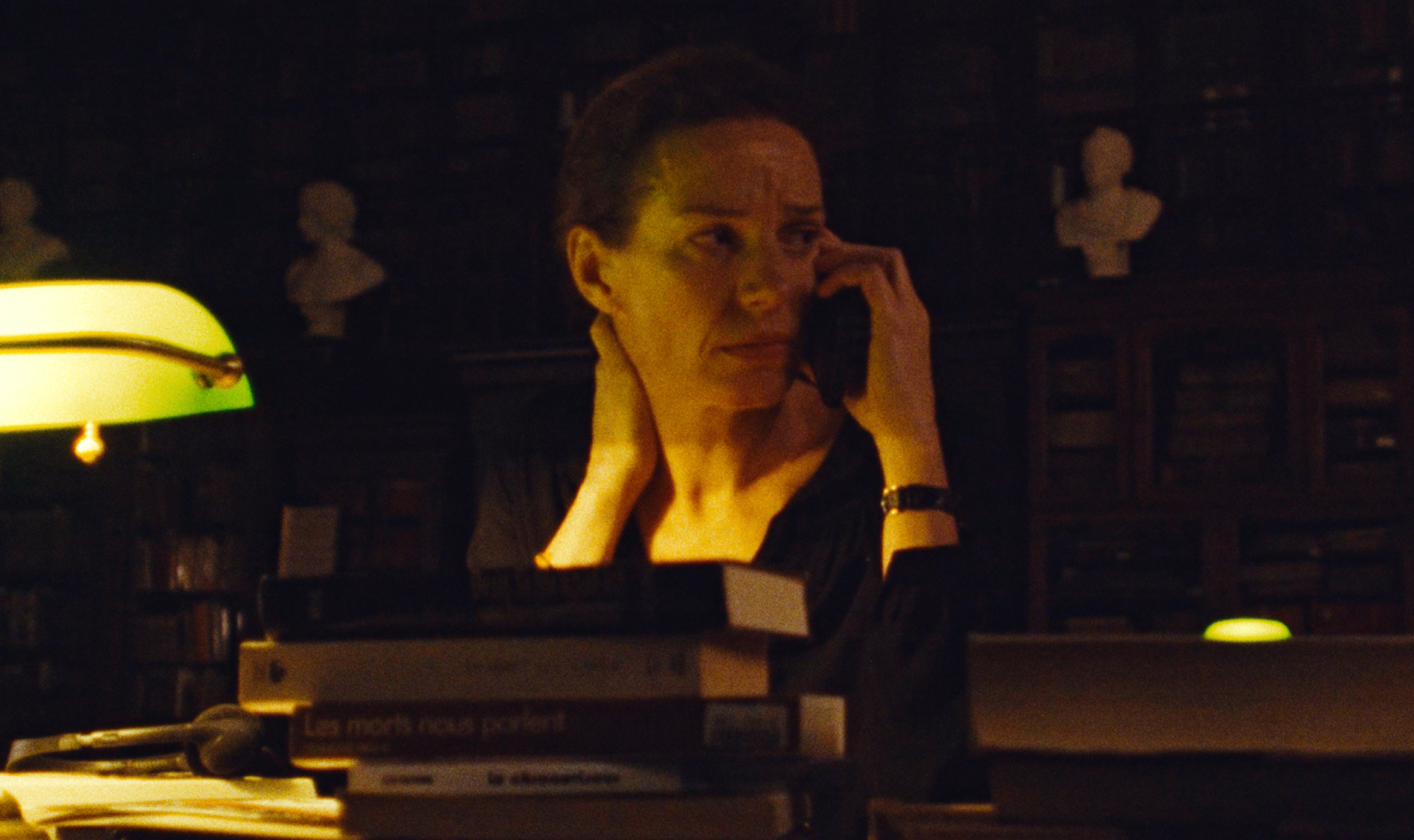
Benedictine monk Father Pellegrino Ernetti claimed to have invented — alongside Enrico Fermi and Wernher von Braun — a device called the Chronovisor, capable of transmitting events of the past as if live on TV. He professed to have witnessed orations by Cicero and the Crucifixion, though the evidence he provided, reported in the Italian press, was widely disputed. Taking this as their jumping-off point, filmmakers Kevin Walker and Jack Auen engage in a form of time travel as well, following Columbia scholar Béatrice Courte (real-life professor Anne-Laure Sellier), who comes across the Chronovisor while researching an unrelated topic and then — like countless hyperlink- or microfiche-surfing grad students before her — gets lost on an academic side quest. Traveling deeper and deeper into a stubbornly analog archive, she unearths an elaborate web of conjecture and conspiracy reaching all the way up to the highest echelons of the Vatican. Dense with on-screen text from real primary sources, scored to music by Gustav Holst, and shot on 16mm in the pooling shadows of many of New York City’s historic libraries, CHRONOVISOR is a witty literary mystery about one of the many secrets that still hide out in libraries — waiting for someone with time, curiosity, and a JSTOR login to come along and disturb the dusty stacks. (Synopsis from Film at Lincoln Center)
“The wildest conspiracy theory you’ve never heard…. Truth or hoax, Jack Auen and Kevin Walker know this is fodder for endless and irresistible speculations, and their terrific feature debut, CHRONOVISOR, treats the titular machine as something between a holy grail and a black hole gobbling up anyone intersecting its orbit…. Nothing in CHRONOVISOR is as magical as the power Auen and Walker bestow on books, and nothing more exhilarating than the belief this film insinuates in those willing to adjust to its strange, hypnotic rhythms — that there are secrets and mysteries everywhere around you.” —Leonardo Goi, The Film Stage

“A spine-tingling and uncanny film that resonates with the vastly expanding powers of networked space and artificial intelligence today, and fears of the erosion of privacy and human autonomy…. It is also, ultimately, a sly and playful reflection on the power of cinema itself, not unlike the Chronovisor, as a portal onto other worlds that can be deceptive and intoxicating.” —Carmen Gray, The Film Verdict

“CHRONOVISOR does nothing if not fetishize pre-digital recording technology…but the invention of any “super-machine” unfortunately must call to mind our current AI-inundated culture…. Diegetic recordings from the Chronovisor as well as the film’s archival props beg similar and familiar questions: What is being cited and what is being hallucinated? Can anyone invested in the technology be trusted to separate the two?” —Dylan Adamson, The Brooklyn Rail