Part of Bleak Week: Cinema of Despair
Sat, Jun 20 at 2:00pm: Introduction from Chris LeMaire, director of programming at American Cinematheque, which created Bleak Week | BUY TICKETS
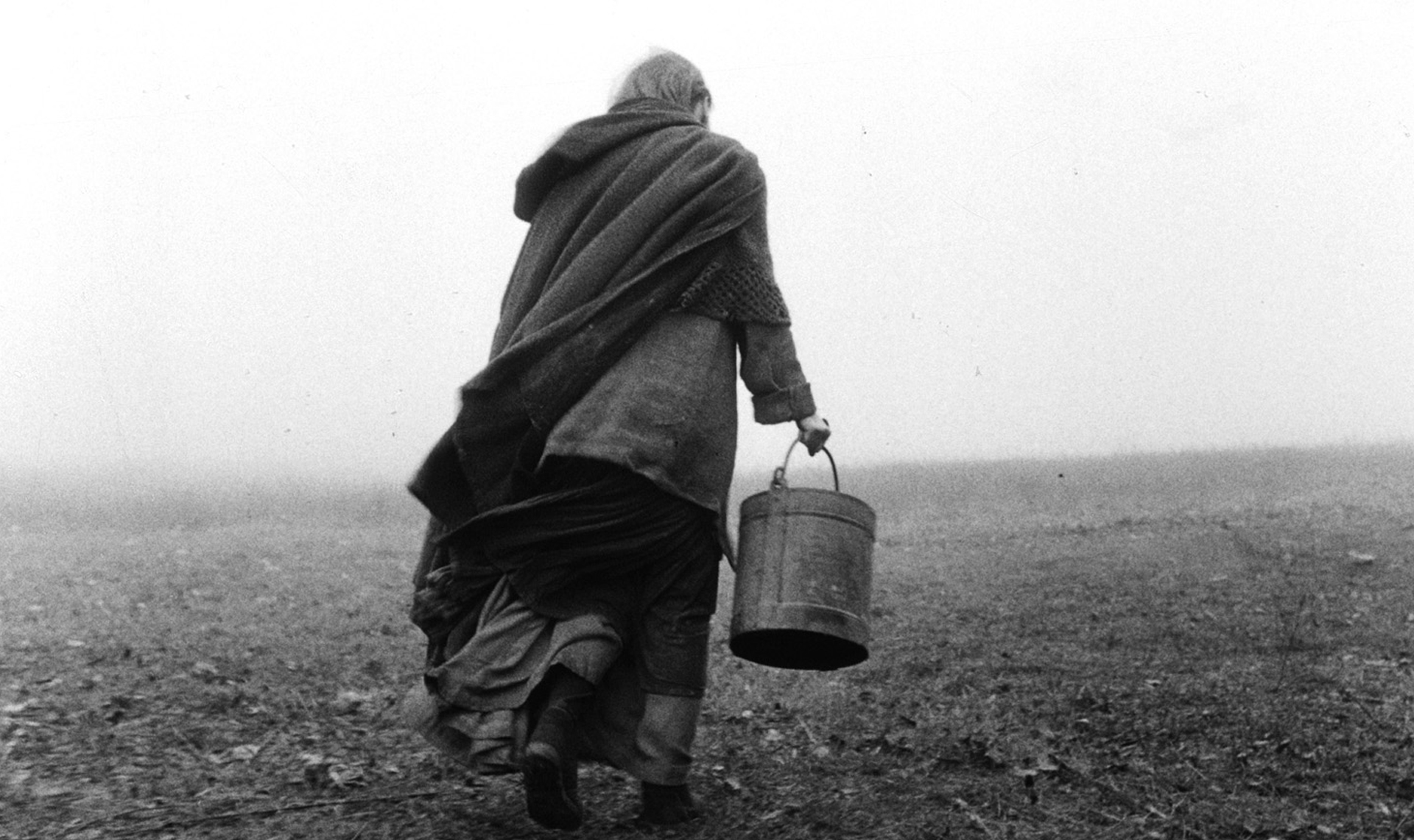
While travelling in Turin, Italy, in 1889, German philosopher Friedrich Nietzsche witnessed a horse being whipped. He tossed his arms around the horse’s neck to protect it, and then collapsed. Less than a month later, Nietzsche would be diagnosed with a mental illness that left him bedridden and mute for the next eleven years, until his death at age sixty-five. But whatever happened to the horse? After opening with this ingenious set-up, The Turin Horse, the final film from Hungarian maestro Béla Tarr, plunges us into a feat of speechless, spellbinding storytelling.
In a film so rich in atmosphere and sensitive to the forces of nature, the howling wind itself constitutes a character, deepening the wrinkles upon the weathered faces of our co-protagonists, an aging farmer and his daughter. Clinging to daily ritual, the pair refuses to let go of life as they know it, even as omens abound that the world might be coming to an end. Only the ailing horse, the pair’s sole means of subsistence, seems to sense the inevitable: he refuses to eat, drink or carry them where they need to go. Nevertheless, the man and his daughter forge ahead with their tasks, even after their one attempt to escape confirms there is nowhere left to go.
Tarr, sharing the director’s chair for the fourth time with his wife and long-time editor Ágnes Hranitzky, has crafted a mostly dialogue-free meditation on how humans refuse to give up the fight even when there’s no battle left to win. The Turin Horse is a film experienced rather than merely watched; one’s ears strain to absorb every note of the monumental end-of-days soundtrack while one’s mental faculties are hurled into reverie, awed by the film’s austere beauty and power. THE TURIN HORSE proves both alluring and devastating to the very end.
See also: SÁTÁNTANGÓ (Sun, May 31 at 12:00pm)
“THE TURIN HORSE is an example — an exceedingly rare one in contemporary cinema — of how a work that seems built on the denial of pleasure can, through formal discipline, passionate integrity and terrifying seriousness, produce an experience of exaltation. The movie is too beautiful to be described as an ordeal, but it is sufficiently intense and unyielding that when it is over, you may feel, along with awe, a measure of relief. Which may sound like a reason to stay away, but is exactly the opposite.” —A.O. Scott, NYT Critic’s Pick, New York Times (Feb 9, 2012)

“An absolute vision, masterly and enveloping in a way that less personal, more conventional movies are not. The film doesn't seduce; it commands.” —Mark Jenkins, NPR

“A film that asks what meaning there is to be found in the daily toil, in the quotidian chore…. The characters’ lives may be insignificant in any kind of larger scheme, but as they unfold on the screen, they are everything. If ever a film had a claim to being profound in its banality, THE TURIN HORSE is it.” —Andrew Schenker, Slant Magazine