Part of Science On Screen® 2026
Thu, Apr at 8:00pm: Introduction and post-screening discussion with Suzana Herculano-Houzel, associate professor, department of psychology and Vanderbilt Brain Institute, Vanderbilt University and author of The Human Advantage | BUY TICKETS
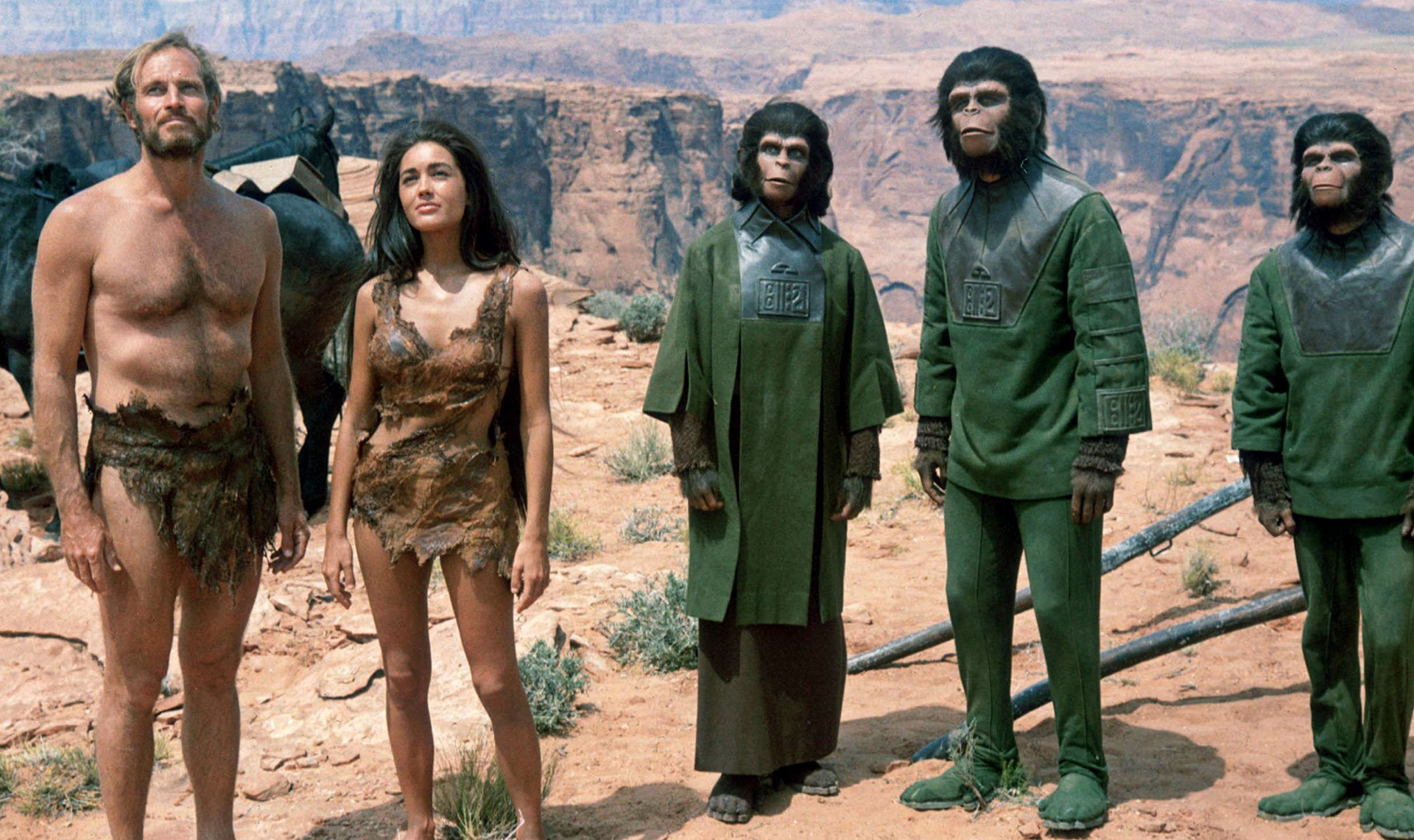
Astronaut George Taylor (Charlton Heston) and crew crash land on an unknown planet in the distant future only to find it is ruled by apes who use a primitive race of humans for experimentation and sport. Made to bear silent witness to this topsy-turvy world, Taylor soon finds himself among the hunted, his life in the hands of a benevolent chimpanzee scientist (Roddy McDowall).
Franklin J. Schaffner’s iconic adaptation of Pierre Boulle’s satirical sci-fi novel of the same name blew audiences’ minds with its outstanding makeup effects –– bolstered by excellent prosthetic-laden acting –– and its bleak reflection on humanity’s cruelty towards others. The film went on to spawn numerous sequels, spin-offs and reboots, solidifying its place as one of the key speculative texts of the last century.
“An amazing film. A political-sociological allegory, cast in the mold of futuristic science-fiction, it is an intriguing blend of chilling satire, a sometimes ludicrous juxtaposition of human and ape mores, optimism and pessimism.” —Variety (Dec 31, 1967)

“PLANET OF THE APES is a very entertaining movie, and you’d better go see it quickly, before your friends take the edge off it by telling you all about it. They will, because it has the ingenious kind of plotting that people love to talk about…. The picture is an enormous, many-layered black joke on the hero and the audience, and part of the joke is the use of Charlton Heston as the hero. I don’t think the movie could have been so forceful or so funny with anyone else.” —Pauline Kael, New Yorker (Feb 17, 1968)

 “It is Taylor's journey — and by that token, Heston's credible, athletic performance — that makes PLANET OF THE APES so much more than a piece of rubber-mask sci-fi hokum… We can admire John Chambers' pioneering simian make-up all we like…but PLANET OF THE APES’ abiding power as a movie rests squarely with the bloke who played Ben-Hur.” —Andrew Collins, Empire Magazine
Topic: What, if anything, is really special about the human brain?
Presentation: PLANET OF THE APES describes a world in which ape-looking creatures are the intelligent ones, and human-looking creatures can’t even speak. Could that ever happen? Could that have happened, instead of the current, modern human world? How did we, humans, end up being the most intelligent creature on Earth? And… are we?
The speaker will set up two scenarios for human evolution before the film, and discuss them with the public after a brief presentation following the film.
Speaker: Suzana Herculano-Houzel, Associate professor, Department of Psychology and Vanderbilt Brain Institute, Vanderbilt University; Author of The Human Advantage, MIT Press (2016); Editor-in-Chief, The Journal of Comparative Neurology
About the speaker: Suzana Herculano-Houzel is a biologist, neuroscientist and science writer and communicator at Vanderbilt University, where she studies brain evolution: what different brains are made of, how they came to be that way, and what difference does that make. Her research showed that human brains are just scaled-up primate brains in many ways, and what sets us apart from other animals is our sheer number of cortical neurons that endow the brain with cognitive flexibility, spurred 2 million years ago by a novel opportunity: the much-increased availability of energy from the novel technologies of processing food. She has been since 2006 a regular writer for the major Brazilian newspaper, Folha de São Paulo; is the author of several books, including The Human Advantage (MIT Press, 2016); and has two TED talks available at TED.com.